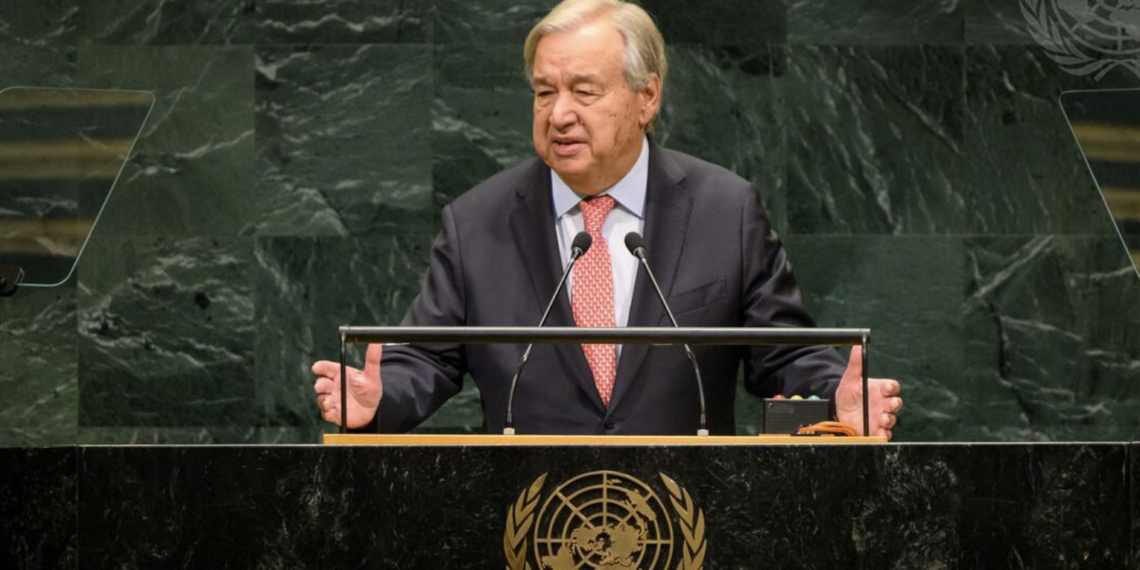
As the General Assembly convenes on the eightieth anniversary of the establishment of the United Nations, well-wishers of the UN – including this author – are reflecting on the current state of the world organization amidst political, financial and moral crises, the structure of international society, the political currents impacting on the Organization, the UN 80 initiative of Secretary-General António Guterres, the aspirations of ‘We the Peoples,’ and the path of wisdom in the way forward for the next Secretary-General, who will commence her or his tenure on January 1, 2027.
The scene that one contemplates is complex. We have the abiding vision of the UN Charter; ground rules of international law in the UN Charter and some tried and tested building blocks for tackling global challenges in the spheres of humanitarianism, peace, development, and human rights. There is an open challenge from the United States of America for the UN to demonstrate its relevance, efficiency and effectiveness coupled with the withdrawal of the USA from some UN entities and agencies and withholding of funds by the USA and some other countries. There are also nuanced expressions of support for the UN Charter from China and Russia, resounding expressions of faith in the UN on the part of the majority of its membership, notably the Group of 77 and the countries of the BRICS grouping. Then there is the UN 80 initiative launched by the current Secretary-General to reform the UN system on the eve of his departure – an initiative whose soundness needs to be placed under the microscope.
A new Secretary-General will need to re-inspire confidence in the UN
From the time that she or he is elected, the next Secretary-General will need to act with the utmost wisdom and discretion, and to pursue a diplomatic strategy calculated to re-inspire confidence in the UN, to work with Member States on issues where the UN is capable of making a meaningful contribution, to insulate the UN from unnecessary controversies to the extent possible, and to inspire ‘We the Peoples of the United Nations.’ The next Secretary-General will need as much room as possible to craft new approaches and strategies and should not be constricted by initiatives launched and decided upon before she or he is elected – including Guterres’ UN 80 initiative.
The position of Secretary-General requires the office-holder to have a finely-balanced combination of vision, political astuteness, diplomatic nimbleness, moral comprehension, administrative acumen, and awareness of the potentialities and pitfalls of the exercise of responsibilities under Article 99 of the Charter. The Secretary-General must be able to communicate her or his vision to ‘We the Peoples of the UN.’ We shall touch on each of these components in turn.
Some thoughts on the diplomatic strategy for the next Secretary-General
First, vision. The Secretary-General has mandates that flow from the Charter and also from decisions by UN organs such as the Security Council and the General Assembly. The Secretary-General would be well advised to highlight and communicate mandates that attract understanding and confidence such as the pursuit of preventive diplomacy; the provision of humanitarian relief and assistance; attenuation of the plight of the poorest; and the enhancement of national human rights protection systems within countries. Through such an approach, the Secretary-General might help give modesty, coherence and cohesiveness to the UN.
Second, political astuteness. The UN is called upon to operate in a very fractious world of great powers and spheres of influence. The task of the Secretary-General must be to promote confidence-building to the extent possible in the circumstances. The Secretary-General must be astute enough to operate as part of the solutions and not part of the problem. In operating as a moral voice, the Secretary-General should be careful to do so without pontificating to Governments. Doing the latter will render the Secretary-General worthless. This is a lesson that goes back to the days of the very first Secretary-General of the League of Nations, Sir Eric Drummond.
Third, diplomatic nimblenes. As much as possible, the Secretary-General should seek to pursue quiet diplomacy, operating behind the scenes as much as possible. Through quiet diplomacy the Secretary-General stands a better chance of influencing decisions. And the Secretary-General should not flood the UN space with pontificated agendas for action. The first Secretary-General, Trygve Lie launched such an agenda to no use and some of his successors, including the current incumbent, have not benefitted from this experience. The current incumbent has nearly a dozen ‘action plans’ of questionable wisdom and utility.
Fourth, moral comprehension. There are undoubtedly great moral issues facing the UN and this situation will continue in the future. The practice that has developed over the years is that the Secretary-General or his spokesperson feels obliged to comment publicly on every issue, day after day. Two things may be said about this: first, the utility of such action needs to be placed under the microscope. Second, the choice of language needs to be reviewed. Steering the UN out of its current predicament will require careful and thoughtful action on the part of the Secretary-General. There must be a balance between wise confidence-building action and expressions of moral concern.
Fifth, administrative acumen. The Secretary-General is the Chief Administrative Officer of the UN. The organization is under assault for alleged incompetence and alleged wastefulness. The Secretary-General should endeavour to run as tight an administration as possible and build up confidence in the world body.
Sixth, exercise of responsibilities under Article 99 of the Charter. Article 99 provides space for the Secretary-General, in the exercise of her or his judgment, to raise global issues or particular situations having a bearing on the maintenance of international peace and security. Activation of Article 99 calls for the exercise of careful judgment on the part of the Secretary-General. The Secretary-General would be wise to consult with the members of the Security Council informally beforehand when she or he is thinking of activating this article.
Seventh, the Secretary-General must strive for greater communication. The Secretary-General must be able to communicate her or his vision to the Member States and to We the Peoples of the United Nations. In so doing, the Secretary-General should strive for trust and confidence. The Secretary-General should be seen as a healer, a bridge-builder, a voice of trust and confidence.
In offering these thoughts, I have been influenced by my experiences as Chief of the Speechwriting Service of the Secretary-General for five years; as Director of the International Conference on the Former Yugoslavia for three and a half years; as Director in the UN Political Department for three years; as Deputy UN High Commissioner for Human Rights for five years; as someone who performed the functions of UN High Commissioner for Human Rights for a year; and as Special Adviser to the UN Secretary-General in particular situations. I wrote the first draft of Agenda for Peace.
When I headed the speechwriting service of the Secretary-General, I received well-meaning advice that the Secretary-General should perform a ‘bully-pulpit’ role. I have come to think that tact, discretion, diplomacy, and political astuteness are of the utmost importance. The Secretary-General must be part of the solutions, not part of the problems.
Dr Bertrand Ramcharan has served many roles at the United Nations. He was a former Chief Speech-Writer for the UN Secretary-General, Director in the UN Political Department; Director of the International Conference on the Former Yugoslavia; Deputy and then Acting UN High Commissioner for Human Rights; and Special Adviser to the UN Secretary-General on the peace process in Georgia. He is the author of Preventive Diplomacy at the UN and Contemporary Preventive Diplomacy.