The UN is about to pick a new Secretary-General. The tenure of Antonio Guterres finishes at the end of the year. Many will breathe a sigh of relief at his departure and nurture a forlorn hope that the next SG will be more determined and more vocal – at least more visible – in addressing the world’s many ills.
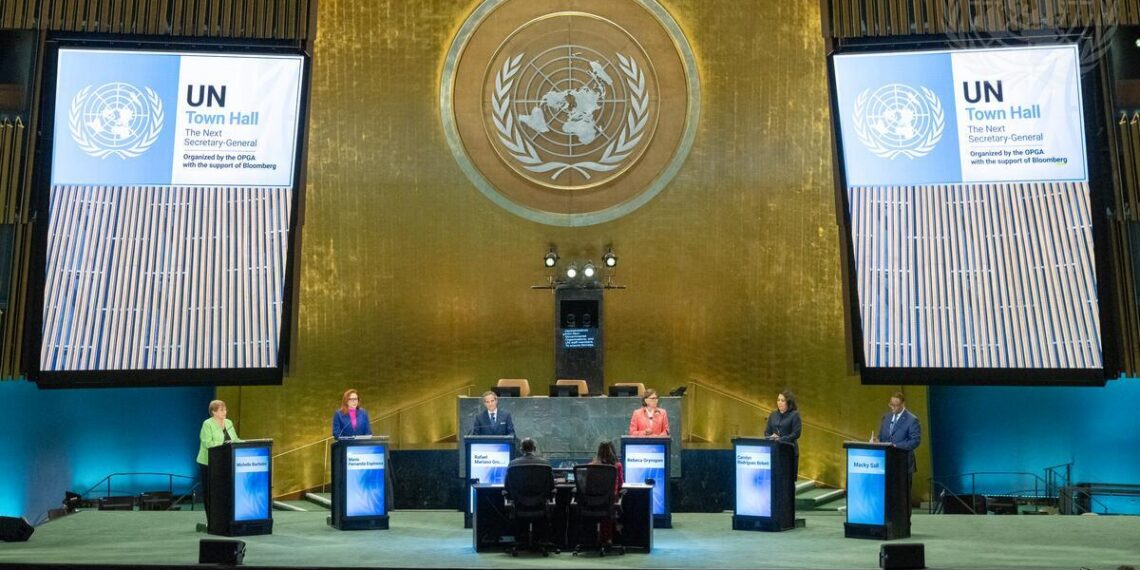
You may have seen news stories about the candidacy of the United Arab Emirates diplomat, Lana Nusseibeh. Other leading candidates include Rebecca Grynspan of Costa Rica or Rafael Grossi of Argentina, the current head of the International Atomic Energy Agency. The accompanying reports might give the impression that there is a reasonable, fair and open process to select the next SG. You will see mention for instance of the candidates facing questions at the General Assembly, in a kind of simulacrum of Congressional nomination ‘hearings’ in Washington, or ‘straw polls’ of the members of the UN Security Council. The process sounds even vaguely democratic.
But like much of diplomacy, and much of what goes on at the UN, this is a total sham. The new SG is selected – in private – by one method and always has been. This has nothing whatsoever to do with the wishes of most member states, and nothing whatsoever to do with democracy. It’s pure power politics all the way down. And like most such rackets, it hides itself pretty well.
It is striking how unknown the candidates are. Guterres was at least formerly the prime minister of Portugal. I’m sure most people have never heard of the current set of candidates. That says a lot about the dwindled prestige of the UN these days. Someone like Angela Merkel, who actually knows about dealing with power – or Putin – and has some profile, would be great for the job but she doesn’t want to do it.
Like the unknown candidates, most people don’t know how the Secretary-General is chosen. The ludicrous chimney smoke ritual of the Pope’s ‘election’ is better known.
At the UN, it’s as if somehow names just emerge and someone is given the nod.
Formally, it’s a simple process. The UN Security Council votes on a candidate, requiring nine positive votes and no vetoes. Then the General Assembly votes on the Council’s recommendation – the winner must obtain two-thirds of the GA members’ votes. In practice, the GA has never refused to endorse the Council’s candidate. Therefore, it’s basically a decision of the Security Council. And we know what that means.
Behind the scenes of the race for the UNSG
Here’s how it’s really done:
- A UN member state – like Portugal – nominates one of their senior diplomats or politicians – if the latter, usually one who’s run out of road in domestic politics i.e. retired, irrelevant, exhausted or, often, a politician who is fobbed off on the UN in order to get rid of them. I remember the UK nominating for a senior job some bumptious and incompetent former Tory minister who had not the slightest ounce of relevant experience, as if the job were some kind of retirement benefit. Many other countries do the same. Senior UN jobs are moderately prestigious, very well paid and often undemanding (though this is by no means true of all of them), with close to zero real accountability if you are incompetent – and you get lifetime US health insurance even after retirement! It is almost impossible to fire people at the UN, particularly the senior people, who have the backing of member states whom the SG needs to keep sweet. You could murder a child and still keep your job.
- Long before the public nomination, the state will start quietly lobbying other member states for their support. This isn’t done on the basis of their qualifications. Heaven forbid! Instead, it’s part of the vote-trading racket behind almost all senior UN appointments whereby countries ‘swap’ their votes i.e. my country will support your candidate for SG and, in exchange, you will support my country’s nomination for a judge at the International Court of Justice or our candidacy for a temporary (sometimes and mostly inaccurately known as an ‘elected’) seat on the Security Council. Diplomats at the UN are pretty open about this. Many appoint a particular member of their delegation to keep track of all the vote-swapping ‘deals’ on an excel spreadsheet or whiteboard in an office (really). The UN is a place where the belief persists that it’s important that ‘our’ guy sits on the court or in a senior position, regardless of their competence. In this way, the UN perpetuates the antediluvian notion of country competition. There’s a sort of ‘tradition’ that the SG should come from each of the regional groups ‘in turn’ i.e. from Europe, Latin America, Africa etc.. That sometimes happens, mostly not. This time not: there are candidates from all over the world. Regardless, it doesn’t change the realpolitik realities of the process.
- Names are tossed about for years, but the formal nominees surface when the appointment process publicly begins and some very late in the day. There may be some public commentary about the candidates, but it is irrelevant, and the current dearth of such commentary tells its own story about the perceived importance of today’s UN. In any case, the member states that really decide who gets the job do not care what’s said about them in public, at all (though the Brits and French pretend to). A few years ago, some member states instituted the idea that candidates should be quizzed in public by the General Assembly. Sounds good, but the candidates of course come armed with sheafs of well prepared and practiced non-answers which are guaranteed ‘not to offend’ because not offending, ideally anyone, is the most important qualification for the job. So it’s not really an interrogation or cross-examination. It’s mostly very boring and inconsequential. It’s only interesting if one of the candidates really screws up and thus disqualifies themselves. This happens rarely.
- During the process, there are a series of secret ‘straw polls’ of members of the UN Security Council. It is not clear to me why these votes are secret. Apparently, it’s supposed to conceal who’s supported by permanent or non-permanent members, but a) it doesn’t and b) I’m not clear what difference it makes anyway. These polls are reported by commentators as if they are a real indication of the Council’s intentions (Grynspan currently leads the ‘straw’ polls). In this way, it appears that there’s a kind of consensus-led, semi-democratic process, at least of the mostly-unelected and often undemocratic members of the Council. There isn’t.
The Permanent Five ultimately decide
And here is where we get to what really is going on. The Security Council, as in all matters, is run by the so-called P5, the five permanent members (US, China, Russia, UK and France). Please do not believe anyone who tells you otherwise. Everybody knows it and for that reason it never needs to be said. It suits the P5 not to say it out loud. It suits the other ten so-called ‘elected’ non-permanent members (only two of whom are actually elected, and then in a process underpinned by the vote swapping described above) to pretend that their presence on the Council matters.
During the pseudo-elections for some of the non-permanent seats, you will hear the ambassadors of candidate countries earnestly declaim that their membership will strengthen international law or reduce conflict or, at least, enable some good to be done in the world. Do not believe it because it is not true. The P5 – particularly the British and French who care about their international reputation – pretend to compliment the non-permanent delegation which proposes a purposeless comma in an unimportant resolution as somehow an indispensable contribution to world peace. But they flatter to deceive. Only five delegations matter on the Council and they decide everything, including the next SG. It’s confusing because everyone pretends otherwise.
The search for a diplomatically compliant leader
How do they choose him – never yet a her, but possibly this year for the first time? Their main concern is whether the new SG will make life difficult for them, as the current SG António Guterres sometimes did, by complaining too loudly about Israel’s conduct in Gaza, China’s repression of the Uyghurs or Russian war crimes in Ukraine. Of course, they know that the SG must now and then make a fuss about these things if they are to retain any credibility. The question is will they complain too much? This is quite hard to estimate (and with Guterres, they clearly underestimated him, at least after his first term when he wasn’t anymore worried about re-appointment and thus felt freer to speak out). To make this assessment, they will gather intelligence by bugging their phone, reading their emails etc, which you can be sure that all five are doing, and is very easy to do, particularly since many international officials seem not to have got the message that Gmail or WhatsApp are not remotely secure (as I recently told a bemused senior UN envoy, who actually laughed when I told him not to use Gmail).
Secondly, they will privately interview them, often when they don’t know they are being interviewed. For this reason, the nominees are often spectacularly boring individuals who have never said anything of note. If they did, they would not be picked. The P5, in particular the Chinese, Russians or US, do not care if Nelson Mandela himself were the candidate if that meant future nuisance for them. They would let it be known he wouldn’t win. As with the veto in general in the Security Council, they don’t have to declare that they would use their veto, they just need to let it be known. It’s a kind of secret power. Thus, the final vote for the SG is usually uncontested. The Council often votes unanimously for the winning candidate, the sure sign that the decision has been fixed in private beforehand, a bit like elections in North Korea or Russia.
So, the end result is an SG who is more or less trusted by the P5 not to mess them about. But that’s not the end of their control of the SG. Should he or she start making trouble, the reaction is instantaneous. The P5 ambassador in New York marches into the SG’s office and reads him the Riot Act. Unlike other countries at the UN, diplomats of the P5 get immediate access to the SG. I have been in such meetings myself. Because it’s diplomacy, the Riot Act is very calmly stated and if you weren’t a diplomat you wouldn’t necessarily be able to tell that it was the Riot Act. But diplomats and particularly the SG know. Pete Hegseth put it with his usual eloquence in another context recently: FAFO. SGs thus know not to FA in the first place. If the SG persists in such unwelcome conduct, then whichever P5 country concerned will get rid of them, as the US did to Boutros Boutros Ghali. All they need to do is say they have no confidence in him or won’t work with him and thus his power is more or less taken away at a stroke.
Notes from the diplomatic frontlines
I was in several meetings with then-SG Kofi Annan where he meekly accepted the orders my ambassador gave him. It wasn’t a pretty sight. One example was when we told him to fire the UN humanitarian chief in Iraq who was making too much of a fuss about the appalling impact of sanctions on Iraqi civilians. He obliged without the slightest objection. On another occasion, he was informed quietly that British intelligence personnel would be secretly deployed among the ‘neutral’ UN weapons inspectors in Iraq (just as I would bet that Grossi has been forced to agree to American or Israeli spies joining similarly ‘neutral’ IAEA nuclear inspectors on their visits to Iran). Against the advice of the UN’s own security chief, Annan submitted to the Americans’ demand that a UN mission be deployed to post-invasion Iraq in 2003 (a way to sort of sanctify their illegal aggression). That mission’s headquarters was then attacked by a suicide bomber, costing the life of many UN staffers, including the UN envoy, Sergio Viera de Mello.
This all sounds terribly cynical but I’m afraid it’s actually the way things are. This is a clear example of how geopolitical power disguises itself. The appointment process appears sort of open, sort of vaguely democratic, at least a real choice of the UN member states. The SG is then treated as a kind of independent voice and authority in the world, whose judgements and condemnations matter. Indeed, the posture of what is often mistakenly called ‘the UN’ is treated as sacred by many otherwise right-thinking people, when in fact they are respecting decisions more or less approved by Beijing, Moscow and Washington.
You may think it doesn’t matter much who sits in the 38th floor office where the SG resides. I beg to differ. We need a staunch and brave voice speaking up for the unlawfully killed, the deliberately-starved civilian, the tortured political activist – the international rule of law. Unfortunately, the SG is unlikely to be that person. Instead, it’s safer to regard them as a kind of symbol of the current geopolitical status quo who speaks accordingly.
There’s always a chance that this time will be different, and I hope this time it really will be. But I’m not holding my breath.
Carne Ross is a former British diplomat who resigned over the Iraq War. He founded Independent Diplomat, the non-profit diplomatic advisory group. Today, he continues to advise democratic governments and political movements, and writes and teaches about power, political change and diplomacy (details at www.carneross.com). You can see the full version of this article on his substack, How Power Works, here.