The United Nations Nation Mission for the Referendum in Western Sahara (MINURSO) was unceremoniously terminated on October 31, 2026 after a showdown in the Security Council between the United States and Russia. Despite having been created with optimism and hope by resolution S/690 of April 29, 1991 of the Security Council to resolve the conflict over the non-self-governing territory by organizing a referendum of self-determination for the people of Western Sahara, its abrupt ending happened without even the formality of a resolution. Instead, the mission’s termination was ushered in when both the US and Russia voted ‘no’ in quick succession for each other’s draft resolutions, thus dashing the hopes of the people of Western Sahara who have been vying for independence for more than 50 years.
While the end may have seemed sudden, the ignominious termination of MINURSO and the Council’s abandonment of the conflict over Western Sahara was put into motion over 22 years ago on April 29, 2004. On this date, under the leadership of the US, with support from France and Spain (at the time an elected member of the Security Council), the Council took a decision that would only serve to perpetuate the conflict. The Council adopted resolution S/1541 which expressed the Security Council’s strong support for the efforts of the Secretary-General and his then Personal Envoy James Baker to achieve a mutually acceptable political solution to the dispute over Western Sahara. The world body seemingly forgot that only two years earlier, in February 2002, the then Secretary-General Kofi Annan and Baker had informed the Council that the parties would not agree to such a solution because both had rejected all attempts to work toward such an end.
A dramatic diplomatic turnaround
For Western Sahara watchers, the diplomatic turnaround was dramatic. On July 31, 2003, through resolution S/1495, the US had played a leading role ensuring unanimous strong support by the Security Council for the Peace Plan for the Self-Determination of the People of Western Sahara as an optimum political solution. Less than a year later, the US led the Security Council in bypassing its previous unanimously adopted decision, without offering any rationale, other than pegging its decision on a seemingly innocuous phrase that the Council had inserted at the end of S/1495, at Russia’s insistence, “on the basis of agreement between the two parties.” This marked the turning away by the US from its previously followed practice of “positive neutrality” in the handling of the Western Sahara conflict in its Security Council role, while also still keeping strong bilateral ties with Morocco.
In his letter of resignation, Baker reiterated to the Secretary-General that during his seven-year tenure, after 14 formal meetings with the parties and neighboring countries together and separately and several informal and separate ones in North Africa and North America where a number of possible approaches to solve the conflict had been proposed. However, Baker acknowledged no solution had gained the acceptance of both parties because both refused to move away from their fundamentally irreconcilable positions. Morocco would not agree to any solution that contained an act of self-determination which would offer independence as an option. The Polisario, on the other hand, would not countenance a solution that would not include the option of independence together with autonomy or even integration with Morocco, as in fact was the case with the options offered in the 2003 Peace Plan.
A trend of sequential meetings sets in
Despite Baker’s acknowledgement of the seeming impossibility of convincing the parties to reach an agreement, the Secretary-General still reassured both parties that the UN remained resolved to help them find a mutually acceptable political solution. In July 2004, the Secretary-General entrusted the handling of the conflict to his then Special Representative, Alvaro de Soto.
By September 2004, the first crisis had erupted, when the efforts by the Special Representative involving contacts and discussions with Spain and France to find a solution were regarded by the Polisario and Algeria as moving away from the Baker Peace Plan. The effort was abandoned and in his October 2004 report, the Secretary-General informed the Council that the political rhetoric by both parties was escalating and that no agreement appeared likely as to what could be done to overcome the existing deadlock.
A new Personal Envoy, Peter van Walsum, was appointed in July 2005, while in October 2005 the Security Council was again informed that the deadlock over an acceptable political solution continued. Morocco continued reiterating its readiness to negotiate over its granting Western Sahara autonomy under Moroccan sovereignty while the Polisario continued to support the implementation of the Peace Plan which included an act of self-determination.
Then, on January 9, 2009, Christopher Ross was appointed as Personal Envoy, because Algeria and the Polisario distrusted van Walsum who resigned. In August 2017 Ross was replaced by Horst Koehler who served until he abruptly resigned in May 2029 for not clearly explained reasons. Following that, current Personal Envoy Staffan Di Mistura was appointed.
A succession of Personal Envoys
The pattern was thus set for appointing a succession of Personal Envoys when one fell out of favor by one of the parties, or was replaced by another individual based on the wish of a member state, or when he realized the impossibility of the task that he had accepted. Meetings between the parties in the presence of the neighboring countries were scheduled regularly with all following the same pattern. The parties were polite and listened to each other and only agreed to meet again, with each making subsequent press statements which reiterated their unchanging positions.
Semantics started playing a key role in the continuation of the management as was the case of the use of “round table” meetings in describing the consultations under Koehler where both the parties and neighboring countries were invited to participate. For Morocco, this meant that Algeria rather than the Polisario was the other party of the Western Sahara dispute and from that point on, it insisted that the phrase be mentioned in all Western Sahara resolutions, which started becoming longer and almost incoherent, with additional language about issues unrelated to Western Sahara.
Security Council hesitant to act on Western Sahara
So far, since 2004, neither the office of the Secretary-General, nor the Security Council as a whole, nor any of the Personal Envoys who have accepted the position, appeared to have reflected upon the fundamental reasons why it has been impossible to find a sustainable solution to the conflict over Western Sahara. While it is true that the Security Council has undertaken the resolution of the Western Sahara conflict under Chapter Six of the UN Charter, meaning it has no power to impose a solution to the parties of a dispute, in the case of Western Sahara this has been carried to an extreme. As a rule, the Security Council has hesitated to even ask the parties to do something they don’t want to do, especially Morocco.
Admittedly, in every conflict or adverse situation coming in front of the Security Council its members do have their bilateral preferences which play a major role in how conflicts are handled. However, after 2004, in the case of Western Sahara, this has been carried to an extreme and in December 2020, the United States linked its overall Middle East policy to that over Western Sahara. Inevitably, this presented additional complications for the resolution of the conflict. And as the next section indicates, this became also one of the main reasons that the conflict entered its current stasis after recognition by the Trump Administration of Moroccan sovereignty over the Territory.
US recognition of Moroccan sovereignty shakes the status quo
In December 2020, the outgoing Trump Administration unilaterally decided to recognize Moroccan sovereignty over Western Sahara by linking it to the just concluded Abraham Accords negotiated by President Trump’s son in law Jared Kushner and intended to resolve the Israel-Palestine conflict by initiating diplomatic relations between Israel and select Arab states, Morocco among them. It was rumored at the time that when the deal was first proposed to the King of Morocco Mohammed VI, he hesitated to agree and was concerned about the implications of such a gesture for his standing in the Arab world as ‘Commander of the Faithful.’ Maybe the King even recognized that such a transactional decision would not help the resolution of either the Palestinian or the Western Sahara conflicts. However, it appears that pressure from Kushner and the King’s principal advisors and the Moroccan foreign minister, convinced the King to agree.
Sadly, the Biden Administration followed this ill-advised policy, based on the same miscalculation about the expected achievements of the Abraham Accords and allowed the Trump recognition to stand. Subsequent events have proved that the King’s hesitation, if this is correct, was wise, because both the Palestinian-Israeli and Western Sahara conflicts currently find themselves in a far worse state than six years ago with neither appearing anywhere near resolution.
The “zero draft” resolution
In its continued manner of underestimating intolerance by international actors when it breaks international legal and moral norms, the Trump administration, with support from France and forbearance by most members of the Security Council, in its handling of the Western Sahara conflict, went a little too far in October 2026. After adoption of the October 2025 resolution S/2797, which was supported by the majority of the Council with abstentions by, Russia, China and Pakistan and accompanied by stern after-vote warnings by Russia and China regarding the direction of the resolution, 10 days before the expiration of MINURSO’s mandate on October 31, the US presented its Western Sahara “zero draft” resolution.
The “zero draft” followed no previous Security Council resolution either in format or substance and had those who read it wondering whether it had been drafted in the US or Morocco. It did away with any of the subtleties or ambiguities that had characterized resolution S/2797 by announcing the renaming of MINURSO to MINUSO, by eliminating its original function of holding a referendum of self-determination as of November 1, 2026. The resolution further asked that the Moroccan Autonomy Proposal be used as the only basis of negotiations, that the Personal Envoy starts consulting with outside Saharawi constituencies and most important that the Office of the High Commissioner for Refugees proceed with preliminary work that would lead to the repatriation of refugees.
Immediately the Polisario issued a statement that if the content of zero draft remained unchanged, it “would have no choice but disengage from the peace process”.
The beginning of the end of the Western Sahara mission
Even after attempts by members who were supportive of the Moroccan position failed to achieve meaningful changes in the United States draft, it was submitted on October 30 for voting by the Council. An alternative resolution along the lines of previously drafted resolutions proposing MINURSO’s technical extension, (usually for mundane practical reasons), but referring to all previous resolutions on Western Sahara adopted by the Security Council, was circulated by Russia in the morning of October 30. In the afternoon of the same day, in a formal, open meeting of the Security Council, for the first time in the history of the Western Sahara conflict, Russia vetoed the US draft despite its support by more than 9 members, the minimum required for the adoption of a resolution.
In quick succession, the Russian draft was circulated for voting, and it elicited only three yes votes from Russia, China and Somalia, while the rest of the Council led by the US who voted no, abstained. According to arcane Security Council rules, the number of abstentions for the Russian draft was essential to ensure its defeat (less than 9 yes votes) thus lessening US liability vis-à-vis Russia despite a visibly angry US Ambassador in the Council chamber. Was ensuring 9 or more abstentions for the Russian draft an attempt not to exacerbate an already testy relationship between the United States and Russia? Was it an attempt to spread the blame of the resolution’s failure among members who were voting in real time without the benefit of the usual consultations preceding formal votes, thus lessening the impact of a double veto by the US and Russian within minutes of each other? It’s hard to say. However, it was not lost to most observers that almost simultaneously with the voting on the Russian resolution, a Royal statement was issued in Rabat asking for MINURSO’s dismantling and departure. And having observed the Moroccan Foreign Minister in Moscow during the recent Africa Summit talking to his Russian counterpart, many suspected that Morocco had been warned by Russia about its decision to veto the American draft and had green lighted it while positioning itself for its next move.
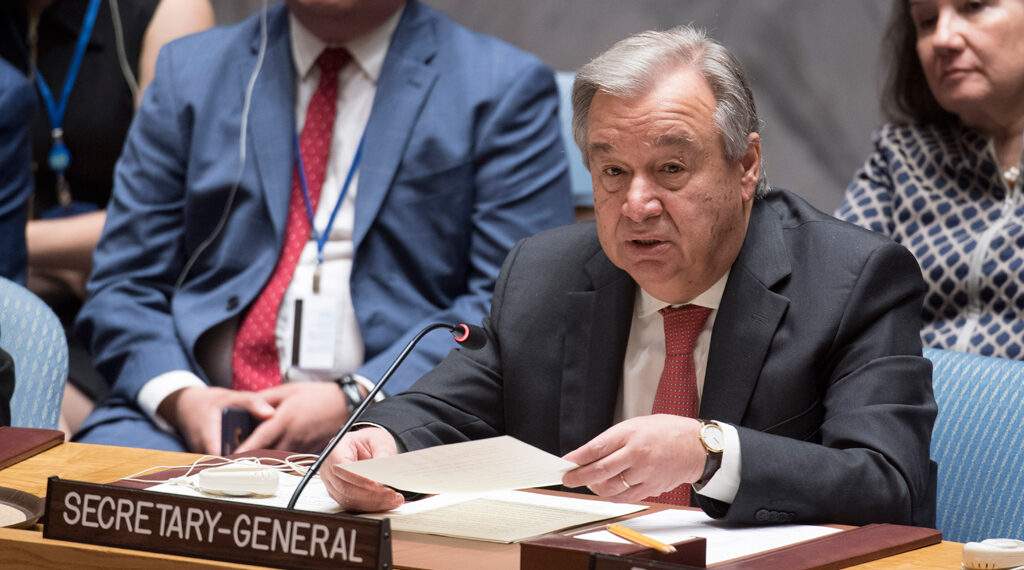
The following day, the Secretary-General issued a matter of fact, practical and unemotional statement announcing the start of MINURSO’s dismantling. He made a point of mentioning that the disappearance of MINURSO did not take away the Saharan’s people’s inalienable rights to self-determination and called on all parties to respect them. However, there was no expression of sympathy or regret for the Saharan people who had been waiting since 1991 for the UN to act decisively.
Where does all this put those most affected by a play by the big powers? .
One should ask the US and UN negotiators why the details of Morocco’s expanded autonomy offer are still a secret, at Morocco’s request, while the resolution drafters demanded that the Moroccan document be the only basis of negotiations?
Why did Council members, not involved in the consultations but nevertheless expected to approve whatever was decided, not ask to see the expanded Moroccan proposal before voting in support of the US draft resolution?
Why, 19 years after Morocco presented its first draft of autonomy offer to the Security Council, which key members rushed to welcome as serious and credible, is Morocco still unwilling to divulge exactly what it is offering?
The details that have leaked about the Moroccan expanded proposal make it sound like an effort to convince Moroccan citizens that Western Sahara is no different from the rest of Morocco’s regions and it will be treated by the central government as such. Given the leaked information about what Morocco is really proposing, coupled with the stern talk by the Secretary-General and his Personal Envoy in their last report about expecting to see Morocco offering a genuine autonomy which would be the subject of a meaningful process of consultations with the people of Western Sahara, the Moroccan proposal sounds unconvincing.
The recent announcement by Personal Envoy Staffan de Mistura during his oral remarks to the Security Council about his agreed initiative with the High Commissioner of Refugees to facilitate confidence building measures to enable eventual repatriation of refugees from the Tindouf camps in Algeria to Western Sahara, is equally unconvincing.
Operative paragraph 6 of the United States draft requested the Personal Envoy to consult “a broad range of Sahrawi constituencies and interlocutors” thus opening the way for other Saharans (hopefully more amenable to Morocco’s proposal) and moving away from UN recognition of Polisario as representatives of the Western Sahara people and therefore as the only UN interlocutors as decided at the creation of the 1991 UN Settlement Plan and that of MINURSO.
Finally, both preambular and operative paragraphs 9 of the United States draft focused on the Western Saharan refugees who escaped when Morocco annexed 80% of the Territory and settled in the Tindouf camps in Algeria. The language in both paragraphs expresses deep concern about the protracted displacement and deteriorating humanitarian conditions in the Tindouf refugee camps and requested completion of registration by UNHCR of all refugees in the camps within 6 months. Without being specific, the vague and ambiguous language is clear enough in its meaning of talking about repatriation of the refugees to Morocco.
Providing relief to the many generations of refugees living for close to 50 years in the inhospitable climate and environment of south Algerian desert would be welcome, if one ignores the July 2026 events in Morocco. At that time, the whole world witnessed thousands of Moroccan citizens, mostly young people, risking death by drowning in their desperate effort to leave Morocco to the Spanish enclaves in the north of the country.
European countries such as Italy, suspended Schengen Agreement checks with Spain, while France reinforced border controls with Spain. Italy, Finland, Denmark, and Czechia, with Sweden also included in the commentary, called for Spain’s suspension from Schengen. Little or no attention was paid by the Europeans, especially those supporting the expanded Moroccan Autonomy offer, sight unseen, about Morocco’s ability to repatriate and resettle the thousands of Western Saharan refugees into its land. Nor did the Secretary-General express any concern about their fate in his statement on MINURSO’s termination.
Russia’s veto of the American resolution offered a temporary relief by blocking, for the time being, their repatriation to Morocco. However, their fate in the camps in Tindouf still remains on the balance.
Anna Theofilopoulou is a former UN official with experience in political and development issues. She covered the conflict over Western Sahara from April 1994 to July 2006 and worked as close advisor to former US Secretary of State, James A. Baker throughout his appointment as Personal Envoy of the Secretary-General on Western Sahara from March 1997 until his resignation in June 2004. She holds a master’s degree in international politics and international business from City University of New York and has written widely about peacekeeping and mediation for academic journals and publications. This piece is part of ICDI’s Maghreb Dialogue Project series.