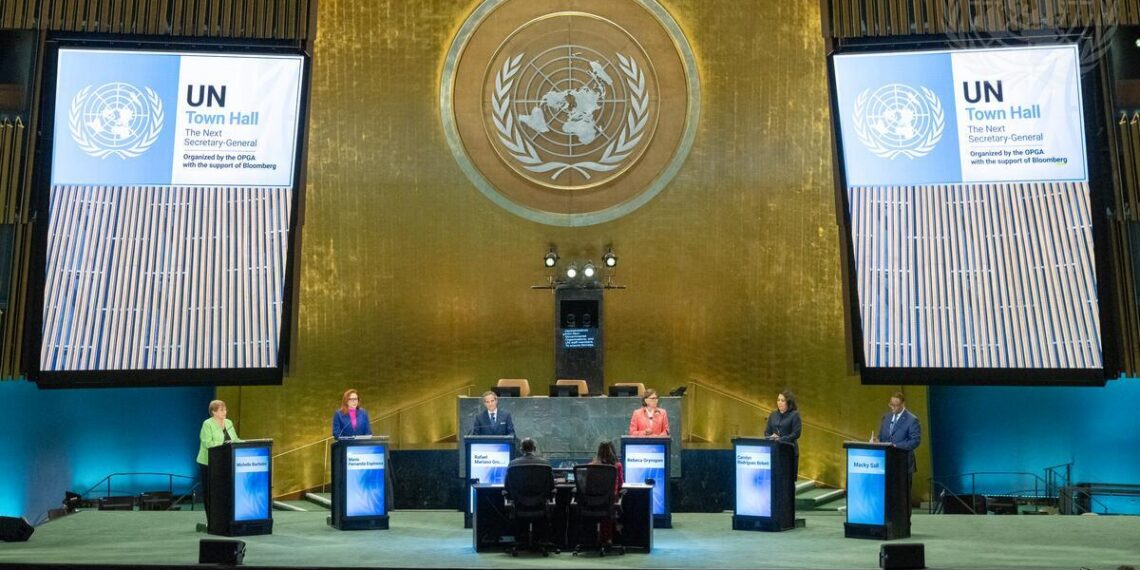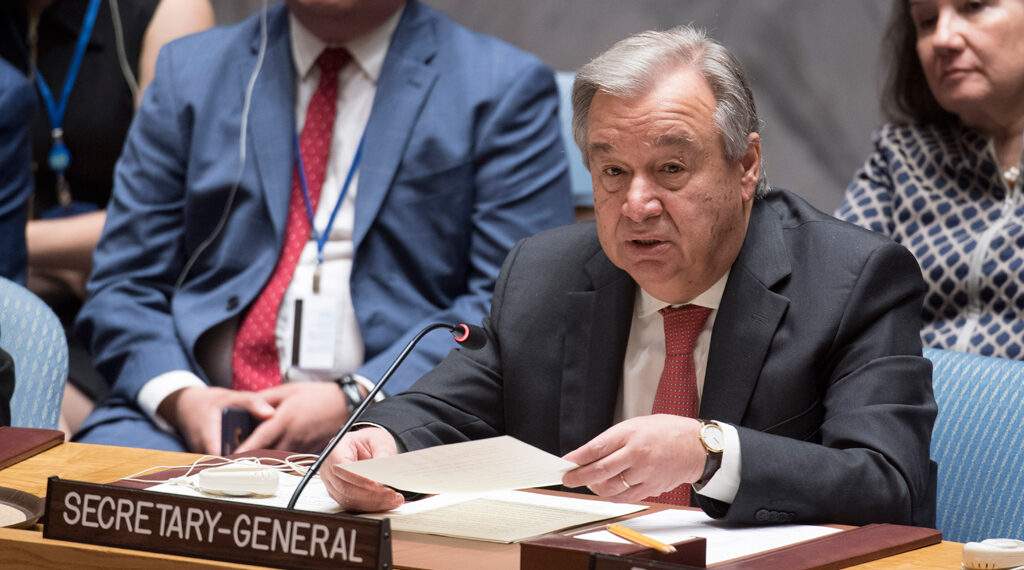
As we enter the final months of the race to find the next Secretary-General of the United Nations, the latest straw polls still don’t point to a clear winner. While the leadership of the world organization hangs in the balance, the UN faces a cataclysmic context of wars in Ukraine, the Middle East and Sudan, a development system in crisis, Permanent Five members who willingly violate some of the fundamental principles of international law, and growing pressure from the Global South for serious structural reform. Will one determined voice be enough to reinvigorate hope in the UN’s ability to manage global order or will the process produce another passive puppet unwilling to lead any serious reform process?
As faith and confidence in the UN declines globally, considering the organisation’s very limited ability to prevent the outbreak of wars, address the root causes of conflict nor ease the humanitarian catastrophes that they have produced, the role of leading the organisation holds limited appeal. Traditionally the position of Secretary-General was filled through a process based on regional rotation and led by the P5 wherein there was limited transparency as to how the outcome was decided. After closed-door negotiations, one candidate would be presented to the General Assembly which always voted to approve the selection. Not only was this procedure largely secretive, constricted in terms of scope as to who may be nominated, which was dominated by the whims and wishes of the permanent members, it also gave rise to concerns about lack of openness, inclusiveness and the further institutionalising of the power of those members.
An attempt at reform in the selection only reaches so far
In 2015, the General Assembly voted to reform the process, though crucially, not the key provisions of how the candidate would be ultimately selected, which is outlined under Article 97 of the Charter. Under the revised system, a more open nomination process was introduced whereby candidates were announced publicly and take part in informal discussions with the Assembly. Adjusting the nomination procedure rather than the selection procedure, the reform does not remove the P5 veto power over the process, but it opens some larger structural issues for the UN.
Firstly, given that candidates must conduct their campaign for election publicly it requires them to actively lobby member-states for support by formulating a clear agenda and positions on key issues confronting the UN. The current race contains eight candidates, all from the Global South and the majority of them women, with three men running. The candidates have laid out their various positions on key issues from UN and Security Council Reform to economic development, international peace and security and human rights and climate change on a publicly accessible webpage. This means that their agenda and visions for the role can be analysed not only by member-states but by the public. While this makes the candidates automatically more accountable, it also opens them up to inevitable criticisms, especially from P5 members, whose vote is crucial.
Secondly, there are some precedents in this race, apart from the fact that the field is dominated by women. According to reports, although this is the longest race so far, it is also one of the most hotly contested. While Rebeca Grynspan Mayufis of Costa Rica leads the latest straw poll, with 12/15 ‘encourage’ votes, she still has three ‘discourage’ votes indicating that she still has work to do to persuade all P5 members. The latest entrant into the race, Lana Nusseibeh of the United Arab Emirates drew seven ‘encourage’ votes in the latest poll but is widely believed to have strong, though not unanimous, support among the P5. To be elected, the candidate must secure 9 affirmative votes out of 15 at the Security Council who may then recommend their election to the General Assembly where the 193 member-states will have the final say.
A growing desire in the Global South to check P5 power
In the dynamics of this race, two issues have become clear. Latin America is in the driving seat. Not only do most of the candidates come from the region, but China has previously indicated its openness towards a Latin American candidate and there is sustained support for Grynspan among Latin American countries. This must be viewed in the context in which there are no permanent members of the region among the P5 despite the obvious leadership of Latin Americans on key issues since the origins of the UN. From the Chilean diplomat Hernán Santa Cruz’s pioneering role in crafting the modern human rights regime, to Argentina’s Raúl Prebisch who created the United Nations Conference on Trade and Development in 1964 (incidentally, the institution that Grynspan has led until 2025) to Sérgio Vieira de Mello the Brazilian diplomat who held the position of UN High Commissioner for Human Rights for only a year until he was killed in a bomb attack on a UN facility in Iraq in 2003. The Latin American prerogative, therefore, is clear through a historical pattern of performative leadership at the UN which offers an illustration of how Latin American agency has already shaped the institution.
Further, the tenor and level of engagement in the current race, set against the backdrop of an increasingly active General Assembly points to the growing inclination to use the opportunity to check the power of the P5. In recent years, clear institutional slippage has taken place between the Security Council and the General Assembly. Efforts such as the Lichtenstein Initiative, and the application of the Uniting for Peace Resolution indicate an increasing push among the non-permanent members of the UN, to use the power of the Assembly to hold P5 states accountable, but also to assert majority and consensus views on issues. This is most obvious in the case of the war in Gaza where unprecedented votes have castigated Israel for its military campaign in the strip and isolated the US from traditional allies. Taken together these actions represent that in practice, the political cost of using the veto has become much higher, especially when Global South countries use collective action strategies to force consensus positions on major questions, despite their internal differences.
The UN pivoting on the precipice of change
Looking ahead, it is clear that the UN is pivoting on a precipice of change in which leadership of the organization will be decisive. While the current candidates have each espoused elements of a vision for its future, what seems to be at the center is the notion of a more equitable global system. The scale of global crises represents a moment that demands a new blueprint for an institutional global order that puts the principle of equity at the center of UN politics. This means disavowing the pessimism of those who argue that it is a process doomed to be determined only by the power politics of the P5. It is entirely such outdated views that perpetuate stale stereotypes of the UN, closing off avenues for the fruitful development of innovative visions which put humanity’s gravest problems on the table to demand collective solutions.
What Latin American and Global South agency have shown over time is in fact the opposite perspective. It is not the whims of the P5 which have determined the future of the UN at every major juncture, but the intervention of member-states collectively at critical moments to carve a pathway towards a fairer world. While the UN certainly has not fulfilled those ambitions, only a non-linear approach to its history and current reality will engender engagement with an organization whose leadership cannot be determined by one candidate but can be deeply impacted by the collective will of the traditionally disenfranchised.
Professor Alanna O’Malley is the Chair of Global Governance & Wealth and Head of the Department of History at Erasmus University Rotterdam.