In the early hours of June 13, 2025, the Israeli Defense Force launched airstrikes on Iranian nuclear facilities and government installations, killing more than 11 senior Iranian nuclear and military scientists in targeted attacks. Israel’s so-called ‘pre-emptive’ offensive was followed by major strikes by the United States on Iranian nuclear facilities. The attacks, which occurred in the midst of diplomatic negotiations between the US and Iran, shocked the world despite tensions between Iran and Israel had been rising since the war on Gaza erupted in October 2023.
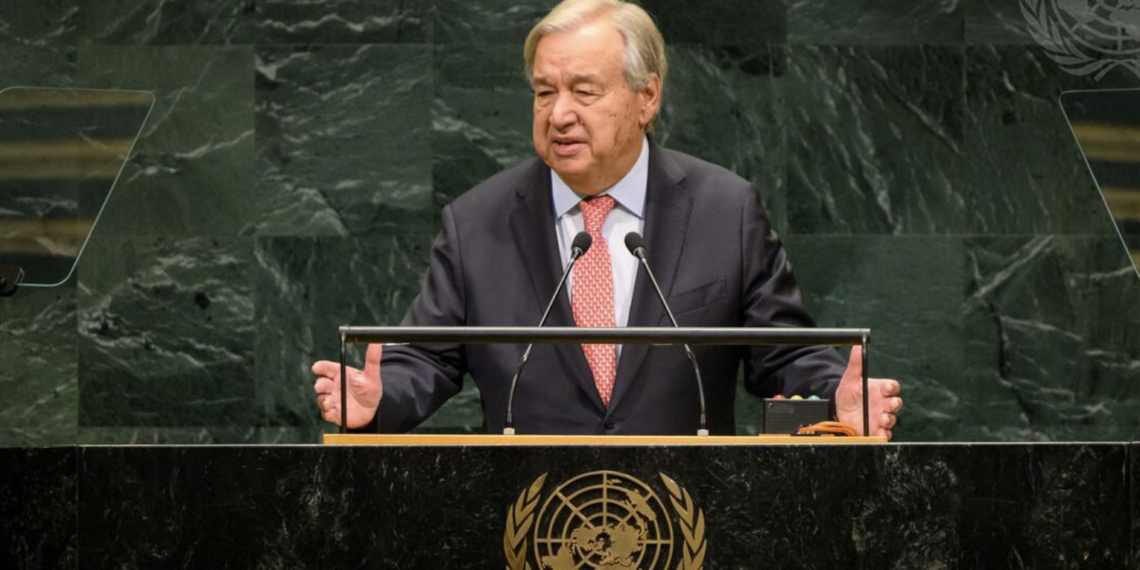
Despite the significance of both attacks, and their implications for both nuclear and political diplomacy, United Nations Secretary-General, António Guterres took almost five hours to respond. The response was measured yet failed to condemn attacks and acts of aggression against Iran that violated UN and international laws and norms.
“The Secretary-General condemns any military escalation in the Middle East. He is particularly concerned by Israeli attacks on nuclear installations in Iran while talks between Iran and the United States on the status of Iran’s nuclear program are underway,” he said in the aftermath of Israel’s strikes.
Double standards in UN diplomacy
The SG used similar language on October 2, 2024, when Iran fired some 250 missiles against Israel as a response to the assassination of Hamas’ political leader, Ismail Haniyeh on July 31, 2024, inside Tehran. Ironically, despite these muted statements Israel responded by declaring the SG as a “persona non grata.”
The following day, on October 3, 2024, SG Guterres addressed a meeting of the Security Council starting his statement with a clear condemnation of Iran. He also reminded all member states of their obligation to act in accordance with the UN Charter and international law.
While the UN Secretary-General used blunt language in condemning the Russian invasion of Ukraine, and its violation of the UN Charter and international law while emphasizing Ukraine’s sovereignty, he failed to use similar language in the case of Israeli and American attacks on Iran.
In the daily briefings, UN reporters including myself, pressed the UN Spokesman Stephane Dujarric about the seeming double standards of the Secretary-General’s clear condemnation of Russia’s attacks on Ukraine, and his muted statements on the attacks by Israel and the US on Iran and received inadequate responses.
“I will leave you to read what the Secretary-General said, and I will leave you with the freedom to interpret and analyze it at will,” Dujarric said.
Security Council holds emergency sessions on the attacks
The UN Security Council, the main organ designated to maintain peace and security, held three emergency sessions in response to Israeli and US attacks on Iran: on June 13, June 20 and June 22. The first two meetings were focused on Israeli attacks on Iran and the last was held following the US attack on three Iranian nuclear facilities in the early hours of Sunday, June 22.
Rosemary DiCarlo, Under-Secretary-General for Political and Peacebuilding Affairs, spoke in the first meeting, the UN Secretary-General spoke briefly in the two subsequent meetings, and Rafael Mariano Grossi, Director-General of the International Atomic Energy Agency (IAEA), spoke in all three meetings. The UN senior officials echoed Guterres’ position, condemning the escalation without naming who started this wave of attacks, avoiding the term aggression and calling for all parties to restrain, assuming that they are equals.
Guterres and Grossi did not refer to the US attack on Iran as an act of aggression or violation of Iran’s sovereignty.
“The United States’ bombing of Iran’s nuclear facilities marks a “perilous turn” in an already volatile region,” Guterres warned during the emergency meeting of the Security Council on Sunday June 22.
Grossi, on his part, cautioned that violence could reach “unthinkable levels,” and that the global non-proliferation regime “as we know it could crumble and fall”.
Division within the Security Council over attacks
Reviewing the statements by members of the Security Council and other speakers, invited to speak at the three sessions, such as Israel, Iran, Iraq and Kuwait on behalf of the six Gulf Cooperation Council’s countries, we can divide the reaction to these developments into three groups:
- Strongly condemning the attacks
- Calling for restraint and de-escalation yet emphasizing Israeli security concerns and its right to defend itself.
- Strongly endorses Israeli and US attacks.
The US and Israel were the only two states from within the members of the Security Council and non-members who strongly endorsed the attacks and justified as legitimate under article 51 of the Charter which authorizes states to defend themselves and conducts pre-emptive strike if there is imminent danger and all other peaceful options had failed.
“This dangerous regime cannot be allowed to have nuclear weapons,” said Dorothy Shea, the United States Ambassador to the United Nations Dorothy Shea on June 13.
“Iran’s leadership would be wise to negotiate at this time,” she added.
“When a regime builds ballistic missiles, enriches uranium to near weapons-grade and openly declares its intent to destroy us, we believe them,” said Israel’s representative. He claimed that Israel did not act recklessly but waited until Iran enriched uranium to a level with that could not be justified as being for civilian use; obstructed inspectors and destroyed monitoring equipment; developed trigger mechanisms; detonation systems and warhead plans; actively recruited more nuclear scientists; and made false concessions during extended negotiations.
US-Israel defends while Russia, China, Algeria, Pakistan, Somalia condemn
In contrast, during the three emergency meetings of the UNSC Russia, China, Algeria, Pakistan, Somalia condemned the attacks as a flagrant violation of international law and a breach of the UN Charter.
Russian Ambassador, Vassily Nebenzia, strongly condemned both Israel and the US for their flagrant violations of international law, underlining those also committed in Gaza. Algerian Ambassador, Amar Benjama, strongly condemned Israeli attacks and pointed out that Israel operates outside the framework of the Treaty on the Non-Proliferation of Nuclear Weapons (the NPT) and has consistently refused to join the negotiation process on establishing a zone free from nuclear weapons in the Middle East.
Pakistani ambassador, Asem Iftikhar Ahmed, said that Pakistan “strongly and unequivocally condemned the Israeli aggression,” he said. “These attacks set a dangerous precedent and pose a grave threat to the safety and security of the people of the region and the world.”
Iraq’s representative condemned Israel’s “dangerous military aggression” against Iran and its “blatant violation of Iraq’s sovereignty and the inviolability of its airspace.”
“It pushes us into conflicts we are not party to,” he said.
The representative of Kuwait, speaking for the Gulf Cooperation Council, also condemned Israel’s attacks — regardless of their justification. Rejecting violations of sovereignty under any pretext, he warned that an expanded conflict will “only serve the forces of chaos and extremism.” When the same ambassador spoke also on behalf of the Gulf Cooperation Council about the US attack on Iran, he chose his words carefully avoiding any condemnation. “We call for an immediate cessation of military actions and exercise of maximum restraint, avoiding anything that could lead to a spillover of this conflict,” he said.
Europe makes muted statements about the need to return to diplomacy
European States who were very critical of the Russian attack on Ukraine and imposed strict sanctions went out of their way to accommodate both the Israeli and US attacks on Iran. The Greek representative, Ambassador Evangelos Sekeris, expressed concern that this escalation occurred as United States-Iran negotiations were under way. “Iran must never be allowed to acquire a nuclear weapon”, and that Israel has the right to defend itself,” he said. “At the same time, we strongly believe that lasting security can only be achieved through diplomacy and a negotiated deal,” he added.
Ambassador of Denmark, Christian Markus Lassen, said “it is further disturbing that IAEA is unable to provide assurances” that Iran’s nuclear program is exclusively peaceful. Nicolas de Riviere, France’s representative, said that such a program “lacks any credible civilian justification.” While the representative of Slovenia echoed these concerns, she stressed: “However, strikes against civilian nuclear infrastructure — whether they happen in Eastern Europe, the Middle East or anywhere else — are unacceptable.”
In conclusion, the three emergency meetings of the Security Council and the several statements issued by the UN Secretary-General, Director of the IAEA, and other UN senior officials have proven beyond any doubt that international law, UN Charter, the equality of sovereignty of all member states are interpreted differently, depends on who is the violator, and who is the subject of the aggression. Only a few countries uphold international law consistently, regardless of whether the attacked state is Ukraine, Iran or Palestine. But sadly may others use different yardsticks if violators, such as Israel and the US, hold military and diplomatic power.
The response of the UN leadership and the Security Council to the attacks on Iran has drawn into sharp focus the unfortunate reality that the UN system still serves the interests of the big powers and veto-holding member states, instead of upholding justice and international law regardless who is the victim. It is no wonder why the UN is now consistently a bystander to the world’s most significant conflicts and has lost credibility.
Abdelhamid Siyam is a UN accredited journalist for the Arabic daily Alquds Alarabi